

Publicly Exposed AWS Keys: How Attackers Exploit Them in 17 Minutes

A single exposed AWS access key can compromise an entire cloud environment in minutes. Modern attackers no longer search manually for leaked credentials they rely on automated bots that continuously scan GitHub repositories, public storage, and developer platforms for exposed AWS keys. Once valid credentials are found, these bots quickly validate access, map IAM permissions, launch malicious workloads, and target sensitive data before developers even notice the leak. Understanding this rapid attack lifecycle is essential for protecting today’s cloud infrastructure.

Table of Contents

What Are Publicly Exposed AWS Keys?

Publicly exposed AWS keys are AWS access credentials that are accidentally published in public repositories, configuration files, or unsecured storage locations. If these credentials remain active, attackers can authenticate AWS API requests and gain unauthorized access to cloud resources. Since automated scanning tools continuously monitor newly published content, even a brief exposure can become a serious security incident.

The 17-Minute Attack Timeline

Time

Attacker Activity

Minute 0

AWS key is accidentally exposed

Minute 1–9

Bots discover and validate the credentials

Minute 10–15

IAM permissions and AWS resources are mapped

Minute 16–17

Infrastructure abuse, data theft, and persistence begin


Minute 0: The Accidental Leak


Most AWS credential exposures begin with a simple mistake. During application development or cloud deployment, developers may accidentally upload credentials to GitHub, include them in Terraform templates, store them inside environment files, or leave Amazon S3 buckets publicly accessible. Although these errors are unintentional, they immediately become visible to automated scanning tools.

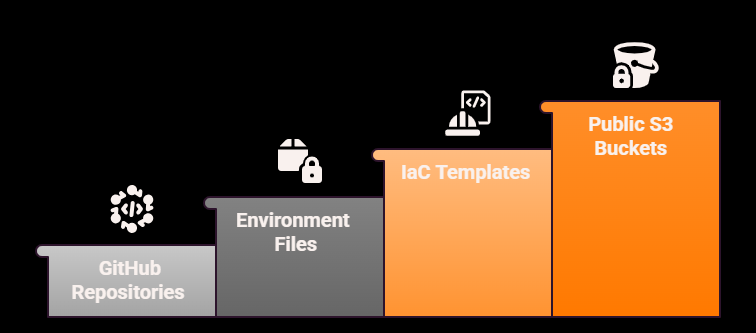
Common sources of exposed AWS credentials include:


  • GitHub repositories: Public repositories are constantly monitored by automated bots looking for AWS Access Key IDs and Secret Access Keys embedded in source code or configuration files. 

  • Environment (.env) files: These files often store cloud credentials for testing purposes. If committed to version control, they provide attackers with direct access to AWS environments. 

  • Infrastructure-as-Code templates: Terraform and CloudFormation templates sometimes expose credentials or reveal insecure cloud configurations that attackers can exploit. 

  • Public Amazon S3 buckets: Misconfigured storage buckets may contain deployment files, backups, or configuration documents that expose sensitive credentials. 

A single accidental upload starts a race between the developer trying to fix the mistake and automated bots trying to exploit it.

Minute 1–9: Bots Discover the Keys

Attackers no longer rely on manual searches. Automated bots continuously monitor GitHub’s public event stream, developer forums, and code-sharing platforms, scanning every new commit for patterns that resemble AWS credentials. As soon as an AWS Access Key ID is detected, the bot immediately validates whether it is still active.

During this stage, automated bots:

  • Identify AWS credential patterns: Pattern-matching algorithms recognize AWS Access Key IDs, Secret Access Keys, and temporary session tokens within seconds of publication. 

  • Validate the exposed credentials: Lightweight AWS API calls confirm whether the credentials are active without triggering obvious signs of compromise. 

  • Collect account information: Bots identify the AWS account, IAM identity, active Regions, and available permissions to determine whether the account is worth targeting. 

By the end of this stage, attackers already know whether the exposed credentials provide access to valuable cloud resources.

Minute 10–15: Mapping the AWS Environment

Once the credentials are validated, attackers begin exploring the compromised AWS account. Rather than launching immediate attacks, they quietly enumerate IAM users, roles, attached policies, trust relationships, and Amazon S3 buckets to understand exactly what the credentials can access.

Attackers commonly investigate:

  • IAM users and roles: Understanding existing identities helps attackers identify administrator accounts and privilege escalation opportunities. 

  • Permission boundaries: Reviewing attached IAM policies reveals whether the credentials can launch EC2 instances, modify resources, or access sensitive data. 

  • Amazon S3 buckets: Storage services are searched for customer records, backups, financial documents, and proprietary business information. 

This reconnaissance allows attackers to plan their next actions while remaining difficult to detect because every request is made using legitimate AWS credentials.


Minute 16–17: Attackers Weaponize the AWS Environment

Once attackers understand what the exposed credentials can access, they waste no time exploiting the compromised environment. If the permissions are broad enough, automated scripts immediately begin launching malicious workloads, accessing sensitive data, and creating alternative access paths. In some cases, attackers have escalated from limited permissions to full administrative control within minutes by exploiting IAM misconfigurations.

Common ways attackers abuse compromised AWS accounts include:

  • Infrastructure hijacking: Attackers launch high-performance Amazon EC2 instances for cryptocurrency mining or unauthorized AI workloads, sometimes referred to as LLMjacking. These activities consume expensive cloud resources and can lead to unexpectedly high AWS bills. 

  • Data exfiltration: Amazon S3 buckets are searched for customer records, financial documents, application backups, and proprietary datasets. Because attackers use legitimate AWS APIs, these actions often appear similar to normal user activity. 

  • Privilege escalation and persistence: Attackers attempt to create new IAM users, generate temporary AWS STS session tokens, or modify IAM roles to maintain access. Even if the original access key is revoked, these changes can allow attackers to return later unless thoroughly investigated. 

By the time the exposed key is detected, attackers may have already established a foothold inside the AWS environment.


How to Defend Against the 17-Minute Blitz
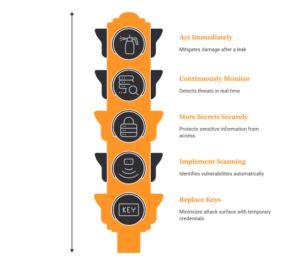
 

Modern cloud attacks unfold too quickly for manual responses alone. Organizations must combine secure development practices with continuous monitoring to reduce both the likelihood and impact of credential exposure.

Follow these AWS security best practices:

  • Replace long-lived access keys with temporary credentials: Use IAM roles, AWS IAM Identity Center, or AWS STS to minimize the risk of credential misuse if a key is exposed. 

  • Implement automated secret scanning: Integrate secret-scanning tools into your CI/CD pipeline to detect exposed credentials before code reaches GitHub or other public repositories. 

  • Store secrets securely: Use AWS Secrets Manager instead of embedding credentials in source code, configuration files, or environment variables. 

  • Continuously monitor your AWS environment: Enable AWS CloudTrail, Amazon GuardDuty, AWS Config, and IAM Access Analyzer to identify suspicious API activity, misconfigurations, and privilege escalation attempts. 

  • Act immediately after a leak: Revoke or rotate exposed credentials, audit IAM users and roles, review CloudTrail logs, and verify that attackers have not created additional access methods. 

Cloud security is no longer just about preventing attacks—it is about responding faster than automated adversaries.


Key Takeaways

Publicly exposed AWS keys remain one of the fastest ways for attackers to compromise cloud environments. From the moment a key is exposed, automated bots can discover, validate, and exploit it in as little as 17 minutes, leaving organizations with almost no time to react. By adopting secure credential management, enforcing least-privilege access, using AWS-native security services, and continuously monitoring cloud activity, organizations can significantly reduce the risk of credential-based attacks.


Build Cloud Security Expertise with C360

Cloud that C360 equips professionals with practical cloud security skills through the AWS Certified Solutions Architect – Associate (SAA-C03) and Microsoft Azure Solutions Architect Expert (AZ-305) certification programs, helping them design secure, scalable cloud environments and advance their cloud careers.

FAQ’s

1. What are publicly exposed AWS keys?

Publicly exposed AWS keys are AWS access credentials that are accidentally shared in public repositories, configuration files, or storage locations. If they remain active, attackers can use them to authenticate AWS API requests and gain unauthorised access to cloud resources.


2. How quickly can attackers exploit exposed AWS credentials?

Automated bots can discover and begin testing publicly exposed AWS credentials in an average of 17 minutes, with some attacks starting in as little as 9 minutes, making rapid detection and response critical.


3. Why are exposed AWS keys a major security risk?

Leaked credentials can allow attackers to enumerate IAM permissions, launch Amazon EC2 instances, access Amazon S3 data, establish persistence, and abuse cloud resources depending on the permissions assigned to the compromised identity.


4. How can organizations prevent AWS credential exposure?

Organizations should use temporary credentials, store secrets in AWS Secrets Manager, enable automated secret scanning, enforce least-privilege IAM policies, implement MFA, and continuously monitor AWS environments using CloudTrail and GuardDuty.


5. What should I do if an AWS access key is exposed?

Immediately revoke or rotate the compromised key, review AWS CloudTrail logs, audit IAM users and roles, investigate suspicious API activity, and ensure attackers have not created new identities or persistence mechanisms.

Categories
Tags
Scroll to Top