

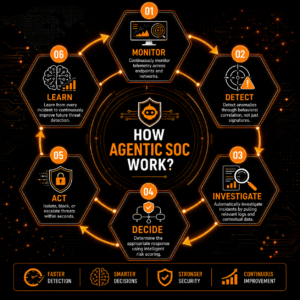
In practice, an Agentic SOC runs on a continuous loop of monitoring, reasoning, and action:
Monitor telemetry across endpoints and networks continuously
Detect anomalies through behavioral correlation, not just signatures
Investigate automatically by pulling relevant logs and context
Decide on a response using risk scoring
Act — isolate, block, or escalate within seconds
Learn from the incident to improve future detection
This loop is what enables AI-driven SOC platforms to cut mean time to respond (MTTR) from hours to seconds for many incident types.
Attackers are building malware with similar agentic capabilities. Instead of static payloads, offensive bots increasingly:
- Adapt their behavior based on the defenses they encounter
- Use generative AI to rewrite code and evade signature detection
- Automate reconnaissance to identify the weakest point of entry
- Coordinate across multiple compromised systems to appear as normal traffic
- Move laterally through a network (lateral movement — spreading from one compromised system to others) while mimicking legitimate behavior
This is no longer humans defending against scripted attacks. It’s a contest between two autonomous systems, each trying to out-think the other — a defining feature of modern AI vs AI cyberattacks. Understanding these attacker tactics from the inside — reconnaissance, exploitation, evasion — is core to certifications like CEH v13, which trains defenders to think like the adversary. How Do AI Agents and Malware Bots Fight Each Other?
Imagine AI-driven malware quietly probing a network, mimicking legitimate user behavior to avoid triggering alarms. A defensive AI agent notices a subtle deviation, a login pattern slightly out of rhythm, a data transfer marginally larger than usual. Instead of waiting for a human to review it, the agent cross-references identity signals, device posture, and historical behavior, then decides within seconds whether to isolate the endpoint.
The malware bot detects the containment attempt and pivots, trying a different lateral movement path or spinning up a decoy process. The defensive agent adapts too, escalating the response or pulling in a specialized agent to handle a specific stage of the kill chain (the sequence of stages an attack moves through, from initial access to final impact; see the MITRE ATT&CK framework for the industry-standard breakdown of these stages).
This back-and-forth can happen in milliseconds, far faster than any human-led workflow, shifting security from “detect and respond” to “predict and preempt.”
Agentic SOC vs Traditional SOC: Key Differences
| Factor | Traditional SOC | Agentic SOC |
|---|---|---|
| Detection method | Signature/rule-based | AI reasoning + behavioral correlation |
| Response speed | Minutes to hours | Seconds |
| Human role | Reviews every alert | Supervises + handles exceptions |
| Adaptability | Static rules | Learns from each incident |
| Scale | Limited by analyst headcount | Scales with compute |
What Are the Benefits and Risks of an Agentic SOC?
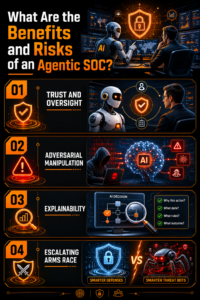
The agentic SOC offers real advantages: faster response times, reduced analyst fatigue, and the ability to handle attack volumes that would overwhelm human teams. It also introduces new risks:
Trust and oversight — how much autonomy should an agent have before human review kicks in?
Adversarial manipulation — attackers may try to poison agent training data or trick decision logic (adversarial AI)
Explainability — analysts still need to understand why an agent took a specific action
Escalating arms race — as defenses get smarter, so do the bots designed to beat them.
Organizations that succeed won’t be the ones that fully remove humans from the loop, but those that pair agentic AI with skilled analysts who can supervise, question, and refine the system’s decisions.
What Tools Power an Agentic SOC?
Agentic SOCs are typically built on a stack of complementary technologies:
XDR (Extended Detection and Response) — unifies signals across endpoints, network, and cloud for broader visibility
AI-driven EDR (Endpoint Detection and Response) — applies behavioral AI at the device level
SOAR (Security Orchestration, Automation, and Response) — automates playbooks and response workflows
Agentic AI layers — sit on top of XDR/EDR/SOAR to add independent reasoning, investigation, and decision-making
Major cloud and security vendors are already shipping agentic capabilities at scale. Microsoft Security Copilot embeds autonomous agents directly into Microsoft Defender for triage, threat hunting, and incident response, while Amazon GuardDuty uses AI and machine learning to continuously monitor AWS workloads and flag multi-stage attack sequences without manual rule-writing. These examples show agentic security moving from concept to production tooling.
How Do You Build Skills for an Agentic SOC Career?
Cybersecurity professionals need more than familiarity with traditional SOC tools. Understanding how AI agents reason, how adversarial AI operates, and how to design human-in-the-loop oversight is becoming a core competency for security careers. Since offensive malware bots increasingly mimic real attacker tradecraft, defenders benefit from thinking like one — which is exactly what the Certified Ethical Hacker (CEH v13) certification trains for.
Career progression:
Beginner: SOC analyst fundamentals — alert triage, log analysis, incident response basics
Intermediate: Security automation and SOAR — building and tuning automated playbooks
Advanced: Agentic AI design and offensive-defense skills — building autonomous agents, adversarial AI defense, oversight architecture, and ethical hacking techniques via CEH v13
A simple 3-month learning roadmap:
Month 1: SOC and security fundamentals (alerting, log analysis, incident response)
Month 2: Automation and AI tooling (SOAR, XDR, AI-driven EDR)
Month 3: Agentic systems and offensive-security fundamentals (autonomous agents, adversarial AI, human-in-the-loop design, and attacker techniques covered in CEH v13)
The AI-Powered Cybersecurity Arms Race
The Agentic SOC represents a fundamental change in how organizations defend themselves, not by replacing humans, but by giving defenders AI counterparts capable of matching the speed and adaptability of AI-driven attackers. As offensive malware bots grow more autonomous, the future of cybersecurity will be defined by how well defensive agents can out-reason, out-adapt, and out-pace them. Staying ahead means continuously upskilling in agentic AI, threat detection, and autonomous defense strategies.
Ready to build these skills?
Start with CEH v13 (Certified Ethical Hacker) on Certify360 to learn attacker tradecraft from the inside — the same techniques agentic malware is now automating. Pair it with CompTIA Security+ for foundational SOC skills, or CISSP if you’re aiming for a security leadership track.
FAQs
1. What is an Agentic SOC?
An Agentic SOC uses autonomous AI agents to monitor, investigate, and respond to threats with minimal manual intervention.
2. How is an Agentic SOC different from traditional SOC automation?
Traditional automation follows fixed rules, while agentic AI adapts, reasons through context, and makes decisions dynamically.
3. Do offensive malware bots really use AI?
Yes. AI can help malware adapt, evade detection, automate reconnaissance, and modify its behavior.
4. Does an Agentic SOC replace human security analysts?
No. Analysts remain essential for high-risk decisions, oversight, and handling complex or ambiguous threats.
5. What tools are used to build an Agentic SOC?
Common components include EDR, XDR, SOAR platforms, and AI agents capable of reasoning and taking action.
6. Is an Agentic SOC safe from attackers?
Not automatically. Attackers can manipulate AI systems, making safeguards, explainability, and human oversight essential.
7. What skills do I need to work in an Agentic SOC?
Key skills include SOC fundamentals, SOAR, AI/ML, adversarial AI, and human-in-the-loop security practices.
8. How fast can an Agentic SOC respond to a threat?
Agents can detect, investigate, and contain many threats within seconds, significantly reducing response time.
9. What are the risks of an Agentic SOC?
Risks include over-reliance on AI, limited explainability, adversarial manipulation, and increasingly sophisticated AI-powered attacks.
10. How do I start learning about agentic cybersecurity?
Start with SOC fundamentals and security automation basics, then move into AI/ML concepts and agentic system design. A certification like CEH v13 builds the offensive-security foundation that helps defenders anticipate how AI-driven malware behaves.